
 By Sylvia Dorrance, REALTOR®, eXp Realty
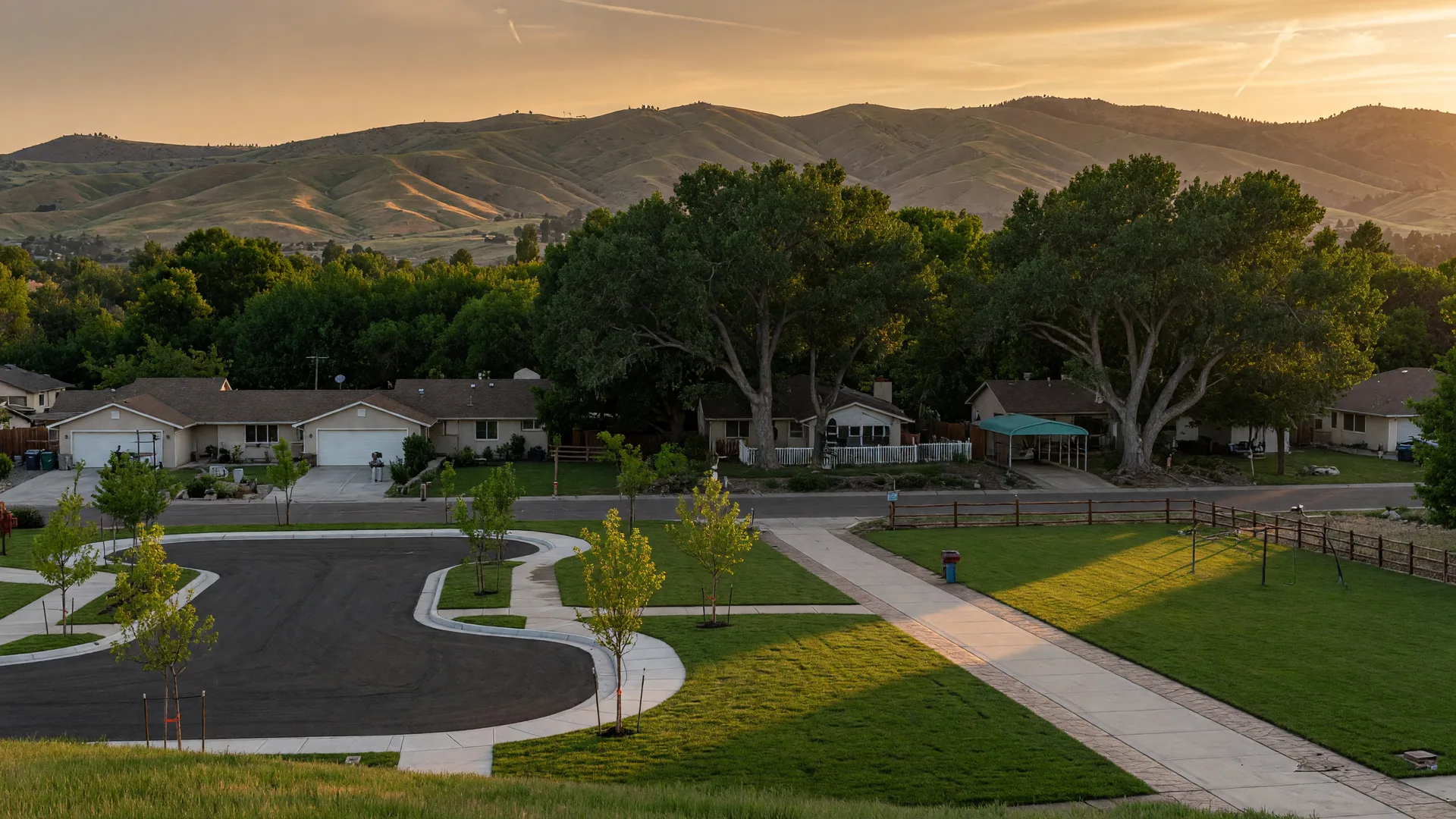
Choosing between a master-planned community and an established neighborhood is a common comparison in the Boise area, known locally as the Treasure Valley. The two options look different on paper and feel different in person, but both are worth comparing on the same set of concrete features: the age of the homes, the size of the lots, the role of an HOA and its covenants, the amenities, the building going on nearby, the trees, and the sidewalks. This guide covers each, describes local examples, and ends with a comparison table you can use on a tour.
What the two terms mean
A master-planned community is a single development built under one plan, with a declaration filed in the county's real property records that includes restrictive covenants governing the residential subdivision, per Idaho's Homeowner's Association Act (Idaho Code 55-3201). A homeowner's association administers the common areas and enforces the rules. An established neighborhood, by contrast, usually grew over decades, built by different owners and builders at different times, with no single recorded declaration and often no HOA at all. Neither is inherently better; they simply run differently, and the differences show up in everyday life.
Age of the homes
In a newer master-planned community, the homes are recent: newer layouts, newer systems, and usually some form of builder warranty, though terms vary by builder. In an established neighborhood, homes were built over many years, so ages vary block to block, and updates depend on what each owner has done. Age itself is neutral: a well-maintained older home with updated systems can outlast a newer home that has not been cared for. The practical step is to check the year built of each specific home and look at the condition of the roof, HVAC, and windows rather than assuming newer is easier.
Lot sizes and outdoor space
Master-planned communities often pair smaller private lots with shared open space, trails, and parks maintained through the HOA, which keeps common areas uniform but adds a monthly fee. Established neighborhoods vary widely: some have generous lots and deep backyards, others are more compact, and the street pattern tends to be more organic. Lot size, fencing rules, and whether the yard is HOA-maintained or fully yours are all written down, either in the declaration or in city zoning, and are worth reading before you make an offer.
HOAs and CC&Rs
The covenants, conditions, and restrictions (CC&Rs) are the rules that run a planned community: what can be built, painted, parked, or rented, and who maintains what. Idaho's Homeowner's Association Act (Idaho Code Title 55, Chapter 32) governs HOAs in the state, covering administration, financial disclosure, and due process. Under the Act, no fine may be imposed for violating the covenants unless the authority to fine is clearly set out in the covenants and restrictions (Idaho Code 55-3206). On rentals, the Act protects owners: An HOA can't add, amend, or enforce a covenant that limits renting, unless the owner agreed to it in writing when it was added, or the restriction already applied when the owner bought the property (Idaho Code 55-3211). The related Ask Sylvia answers go deeper on what CC&Rs are and how HOA fees work in the Boise area , and this post is not a substitute for reading the actual declaration for the community you are considering.
Amenities
Master-planned communities typically include amenities funded through the HOA: pools, clubhouses, parks, trails, and maintained entryways. Established neighborhoods rely more on public amenities: city parks, the Boise River Greenbelt, and commercial streets that grew up around them. Both types of amenities appear across the Boise area, so the question is really which kind you will actually use.
Construction nearby
A newer community may still be building out, which can mean construction traffic, noise, and unfinished streets for a year or more, balanced by the chance to buy early in a neighborhood's life. An established neighborhood is generally built out, so what you see is what you get, with the tradeoff being older infrastructure that cities maintain over time. The Ask Sylvia answer on buying new construction covers the timing and builder questions in detail.
Trees and sidewalks
Mature trees take decades to grow, which is why established neighborhoods like the North End and East Boise feel shaded and settled, while newer communities have younger trees that will fill in over time. Sidewalks and streets in Ada County are built and maintained by ACHD, which plans bicycle facilities as part of every roadway project, so newer communities are often built with sidewalks and bike lanes from day one, while established areas may have sidewalks added over the years. If walkability is part of the decision, look at the actual street section: sidewalks, curbs, bike lanes, and whether the neighborhood connects to parks or commercial areas.
Local examples
The Boise area offers both types close together. Master-planned communities include Legacy in Eagle, Tuscany in Meridian, Hidden Springs near the Boise Foothills, and Lakemoor in Eagle, each with its own character, amenities, and covenants. Established areas include the North End in Boise, with older homes, mature trees, and a walkable grid near downtown, and East Boise, with longtime neighborhoods along the river and foothills. The community pages on this site describe each of these places, and it is worth reading them alongside this comparison. The related Ask Sylvia answers on CC&Rs , HOA fees , and new construction , plus the townhome vs. single-family post , go deeper on the specifics without repeating them here, and this post links to them.
| Feature | Master-planned community | Established neighborhood |
|---|---|---|
| Age of homes | Newer, built under one plan | Varies, built over decades |
| Lot sizes | Often smaller, with shared open space | Vary widely; often larger |
| HOA and CC&Rs | Recorded declaration; HOA enforces | Often none; city rules apply |
| Amenities | HOA-funded pools, parks, trails | City parks and local commercial streets |
| Construction nearby | May continue for years | Generally built out |
| Mature trees | Young trees, fill in over time | Often mature and shaded |
| Sidewalks and streets | Built in with the development | Added over time; maintained by ACHD |
The takeaway
The best way to compare is to read the documents and walk the streets: ask for the declaration and CC&Rs, check the plat map for lot lines and common areas, look up HOA fees and what they cover, and visit on a weekday evening and a weekend morning. The right choice is the one that matches how you actually want to live, and both types of communities, described purely by what they contain, are well represented across Boise, Meridian, Eagle, and Star in the Boise area.
This is general information, not legal or tax advice. Read the actual covenants and governing documents for any community you are considering, and confirm current rules with the HOA or your title company.
Sylvia's take
Before you fall for the floor plan, read the declaration and walk the street. The CC&Rs, the trees, the sidewalks, and what's still being built nearby will shape daily life as much as the house does.
Frequently asked questions
What are CC&Rs?
Covenants, conditions, and restrictions recorded with a subdivision that govern what owners can do with their property; the Ask Sylvia answer on CC&Rs (linked at /ask-sylvia/what-are-ccrs-and-how-are-they-different-from-hoa-rules/) covers them in depth.
Do all homeowner's associations have the same rules?
No. Idaho's Homeowner's Association Act sets statewide standards, but each community's declaration is different, so read the one for the property you are considering.
Can an HOA fine me for any violation?
Only if the authority to fine is clearly set out in the covenants and restrictions, per Idaho Code 55-3206.
Do master-planned communities always have an HOA?
Nearly all do, because the declaration creates the association to maintain common areas and enforce the covenants.